
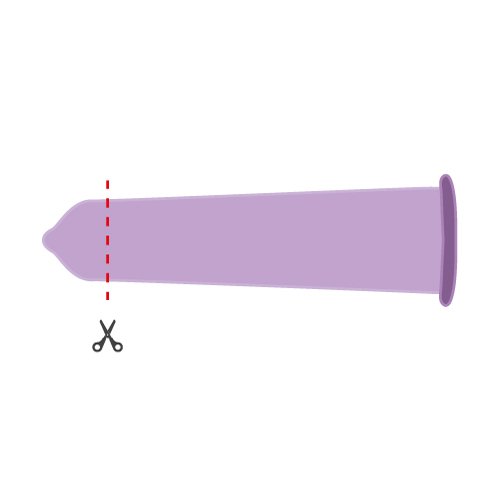
1 – Unroll the condom and cut off the tip with sterilized scissors.
In addition to condoms and other contraceptive methods, there are additional measures you can take to protect yourself during sexual intercourse, including products such as lubricants, latex bands and gloves. Below, find out how to use them correctly and what they’re for.

Lubricants
Using lubricant is very important because, in addition to making sex more comfortable and pleasurable, it also helps prevent the condom from slipping off.
You should choose a lubricant that is compatible with the condom you are going to use and that doesn't cause irritation.
Don't forget to store the lubricant in a place that is not exposed to sunlight or heat, just like condoms. You can choose to store them together.
Water-based lubricants are the most recommended. Oily lubricants, such as Vaseline, massage oils, and moisturising creams or lotions, heat up the latex and can compromise the effectiveness of the condom.
It’s always important to use lubricant, but there are situations where it becomes essential:
- If you start the sexual encounter with oral sex, saliva will remove the lubricant that comes with the condom. In this case, and if you don't have the opportunity to replace the condom as you change the area of penetration. You must apply plenty of lubricant to help keep the condom strong and intact.
- During longer sexual activity, it’s normal for a condom to lose lubrication and and wear down. Ideally, the condom should be replaced regularly and whenever you switch sexual practice or change the area of penetration. However, if that isn’t possible, use plenty of lubricant.
- Lubricant is essential for anal sex. The anus doesn’t produce natural lubrication, and anal sex is usually more vigorous. Not using lubricant can make intercourse uncomfortable or painful and increases the risk of the condom breaking. It’s important to remember that anal sex carries the highest risk of transmitting infections if not properly protected. For this reason, always use an extra-strong condom and a compatible, high-quality lubricant.
Other materials
There are other materials that can be used for your protection.
Dental dams
Dental dams are rectangles of latex used to protect oral sex in the vagina and/or anus.
These act as a barrier between the mouth and the vagina and/or anus, preventing the transmission of infections such as herpes, HPV, chlamydia, gonorrhoea, among others.
You will hardly find latex bands for sale in pharmacies, and few condom distribution teams have bands to offer. You can purchase latex bands by ordering them online.
You can make your own latex barrier using an external or internal condom:
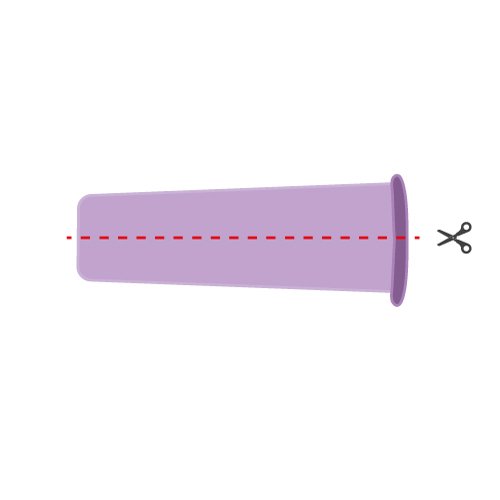
2 – Next, cut the condom vertically.

3 – Open it and you now have your latex barrier.
To use it, simply apply lubricant to the area where you want it to adhere and place the barrier on top. If you are the receiver of oral sex, make sure the barrier stays in the correct position.
Latex gloves
Latex gloves are also an important protective material in certain sexual situations.
For example, when inserting fingers or during fisting (penetration with the hand and forearm), gloves protect the area of penetration by preventing direct contact between the hand or nails and the vaginal or anal area.
In these situations, and for footing (penetration with the foot), an internal condom can also be used.
Masks and Face Shields
Currently, we face other concerns that may justify the use of a face mask or shield during the provision of sexual services.
However, using these protective items alone does not guarantee protection against COVID-19 or other respiratory infections, nor does it prevent their transmission.
Other precautions are equally important, such as hand hygiene, cleaning clothing, and disinfecting all surfaces that may be exposed to the virus.