
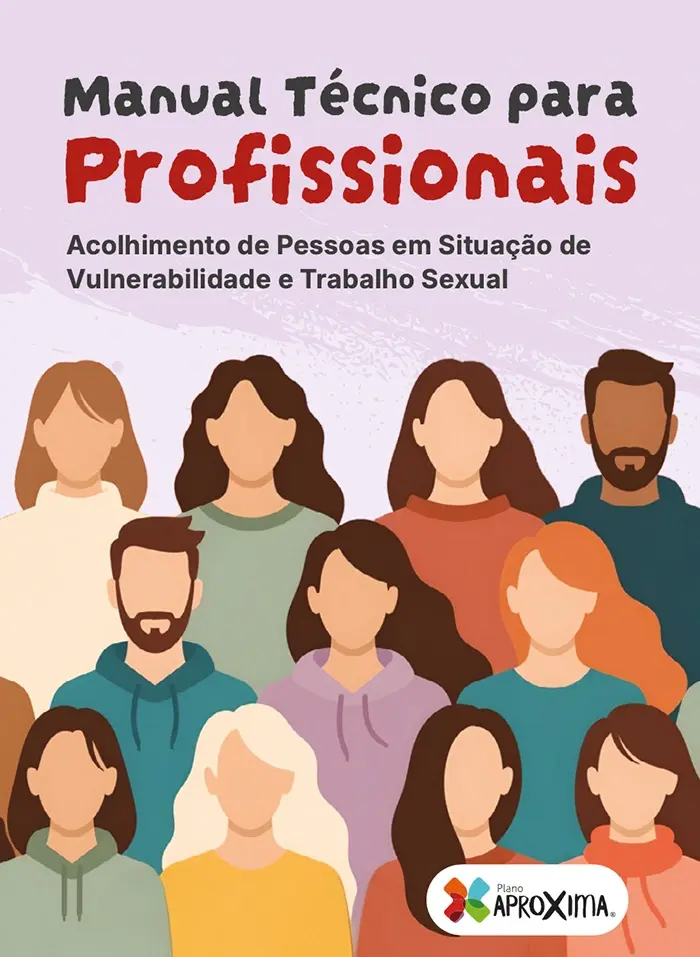

TECHNICAL MANUAL FOR PROFESSIONALS
Support for People in Situations
of Vulnerability and Sex Work
Format:PDF
Author: Plano AproXima
Collaborators:
- Grupo Partilha de Vivências
- MTS — Movimento dxs Trabalhadorxs do Sexo
- APDES — Porto G
- Obra Social das Irmãs Oblatas
- Ares do Pinhal
- Associação Existências
- Ser Mais
- APF
- Associação 6
- GAT
- Associação Positivo
We would like to thank Dr Raquel Azevedo for her clinical contributions.
A reference document for a non-judgemental approach
-
Contact and reception
To promote relationships with service users based on active listening, respect for each person’s decisions and a greater understanding of the different circumstances of sex workers.
-
Stigma and discrimination
To contribute to breaking down prejudices and promoting new perspectives on sex work, through an approach free from moral judgements and stigmatising language.
-
Health and wellbeing
Adopting empathetic and inclusive approaches that contribute to the health and wellbeing of sex workers, by facilitating access to screening, prevention, mental health care and appropriate responses to situations of problematic substance use.
-
Safe and responsible practices
Identify signs of violence, coercion and vulnerability, ensuring appropriate referral where necessary, and protect people’s confidentiality and privacy when collecting, sharing and storing personal data. -
Community networking
To promote an integrated, coherent and person-centred response through coordination between different organisations and services. To facilitate cooperation between health services, social support services, legal services and community organisations, thereby contributing to more appropriate referrals, continuity of care and responses tailored to each person’s needs and choices.
What you’ll find, chapter by chapter
Whether you’re just starting out working with sex workers or already have years of experience in the field, this handbook is for you. Explore it, see how it can help you, and make the most of it in your day-to-day work.
We explain what the handbook is for — to support a more ethical, informed and non-judgemental approach — and who can use it: outreach teams, healthcare professionals and technical staff at public institutions who, in their work, come into contact with people in vulnerable situations.
Before heading out into the field, it is important that you are familiar with the language and principles that guide outreach work. We explain why we prefer to use the term ‘sex work’ rather than ‘prostitution’ — and why this choice of words is, in itself, a form of support.
In addition, this section covers the principles that should always guide your practice: dignity, harm reduction, confidentiality, empathy and, above all, zero judgement. These principles will serve as your compass for all the decisions you’ll make going forward.
It is very common to have a single, simplified view of who sex workers are — and it is precisely this view that this chapter debunks. We show how gender, migration, age, background and substance use intersect and make each person and each situation different from the others.
We also explain what the law in Portugal says: sex work is not a crime, but there is a legal loophole that is worth being aware of — not least so that you can clearly distinguish sex work from pimping and human trafficking.
Now let’s get down to the practicalities: how to create a space where people feel truly safe to talk to you. Confidentiality, active listening, outreach work and networking — all of these matter, and we’ll explain how.
We’ve also organised, by area, the support services you can access — sexual and mental health, social support, legal support — and we’ve set out clear guidelines on how to handle data responsibly, in accordance with the GDPR.
Stigma may not seem like a form of violence, but it is. We explain why, and give you practical tools to tackle it in your day-to-day practice — from the language you use to the environment you create.
We’ll also look at the warning signs and appropriate ways to intervene — physical and psychological violence, economic violence, barriers to accessing healthcare, or human trafficking — so that you know how to identify each one and take action in good time.
We believe it is important to pause here and debunk, myth by myth, the most common misconceptions about sex work — from the confusion with human trafficking to the belief that criminalising the client protects sex workers.
These are phrases you have probably heard before, or perhaps even thought yourself. We are replacing prejudice with facts, so that your approach is always based on reality rather than stereotypes.
This is probably the chapter you’ll consult most often. We’ve put together a practical guide, with phrases and questions you can use during a consultation — such as how to introduce yourself, how to discuss sexual health and substance use, how to end a conversation confidently, and how to respect each person’s gender identity.
We’ve also included a guide to spotting warning signs, so you can tell if something isn’t quite right, without ever invading anyone’s personal space.
Not every situation has to be fixed by you. The important thing is to know who to turn to and where to refer each case. We’ve put together a list of the organisations you can contact whenever a situation requires more than you can provide — the National Health Service (SNS), APAV, CIG, APF and others — indicating the scope of each organisation’s work.
That way, whenever you need to refer someone, you’ll know where to send them and why.
Everyone has the right to decent housing, without exception. We explain, in simple terms, what Portuguese law says about tenancy agreements, discrimination in access to housing and eviction.
For sex workers, access to housing can be particularly difficult due to stigma, discrimination or financial instability. Knowing one’s rights is therefore an important tool for providing more informed support and helping each person make their own choices.
We also provide guidance on where to seek legal support, for cases where the person you are supporting needs more than just information.
This chapter is designed to be a quick reference guide, whenever you need it. We’ve put together referral flowcharts, everything you need to know about PrEP and PEP, and three checklists — for initial assessment, risk assessment and referral — for you to take with you to consultations and outreach visits.

TECHNICAL MANUAL FOR PROFESSIONALS
Support for People in Situations
of Vulnerability and Sex Work
Access all the content — concepts, practical guides, workflow charts and checklists — in PDF format.